
Pop Goes the Dragon: Inside the Collapse of China's AI Stock Bubble

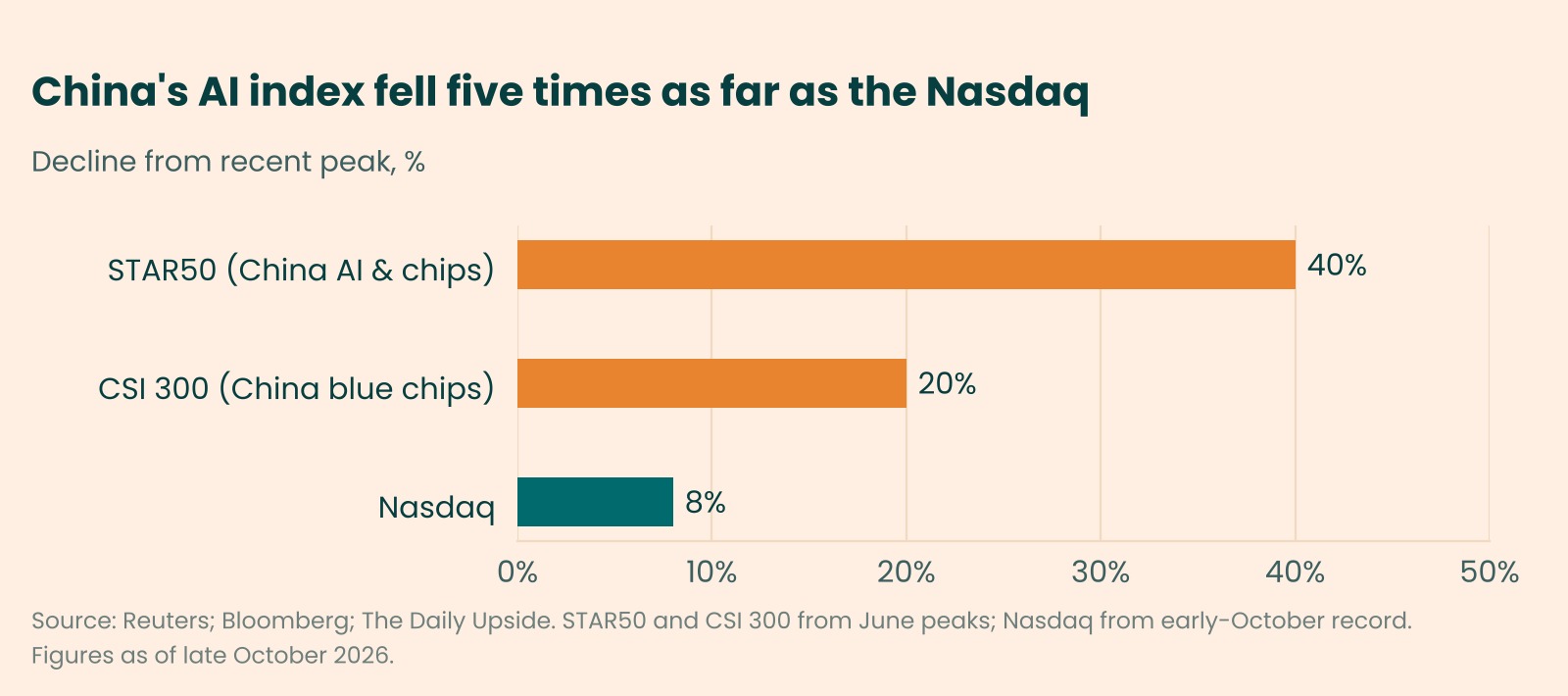
While Wall Street argues over whether there is an AI bubble at all, China has already lived through one. In under four months, the country's flagship index of AI and chip stocks lost 40% of its value and close to half a trillion dollars, leaving retail savers with heavy losses and Beijing trying to steady a market it had spent two years talking up.
The Numbers Behind the China Stock Market Crash
According to a Reuters analysis published on October 26, the STAR50, Shanghai's index of AI and semiconductor leaders, fell about 40% in less than four months, erasing roughly $480 billion in market value. The damage spread well beyond Chinese AI stocks. On October 22, the CSI 300 benchmark of the country's 300 largest listed companies entered a bear market, down 20% from its June peak after 10 straight weeks of losses, and the selling spilled into Korea, Japan and Taiwan.
The stock market later evolved into a speculative crazy bull. And now we see the bubble bursting.
Dong Baozhen, Beijing-based fund manager, speaking to Reuters
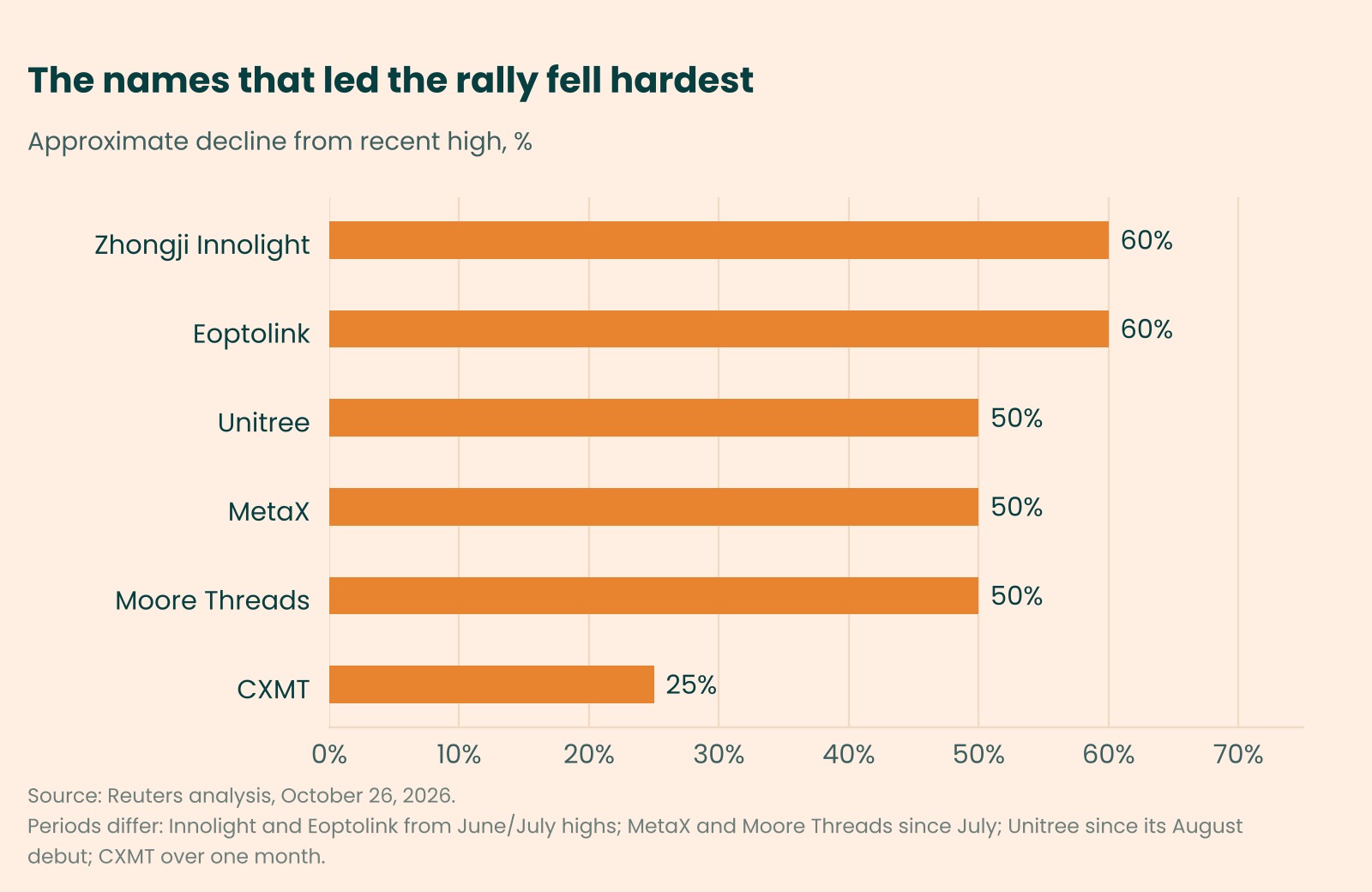
The names that carried the rally took the hardest hits:
• Unitree, the humanoid robot maker whose August IPO was about 8,000 times oversubscribed by retail buyers, has lost roughly half its value since its first days of trading.
• MetaX and Moore Threads, GPU designers that jumped 700% and 400% on their market debuts, have each lost about half their value since July.
• Zhongji Innolight and Eoptolink, suppliers of optical modules for data centers, are down about 60% from their June and July highs.
• CXMT, the memory maker, fell more than 25% in a single month.
October alone took the CSI 300 down 8.5%, its steepest monthly decline in more than a decade. For anyone looking for a real-world example of an AI stock bubble, China has now supplied one.
How the AI Stock Bubble Was Built
The rally started with policy. Beijing's stimulus push in September 2024 set off a run in Chinese technology stocks, and the STAR50 went on to gain about 230% by its June 30 closing high. Officials spoke openly of a “slow bull” market and encouraged households to move their savings into equities that would fund the country's technology ambitions.
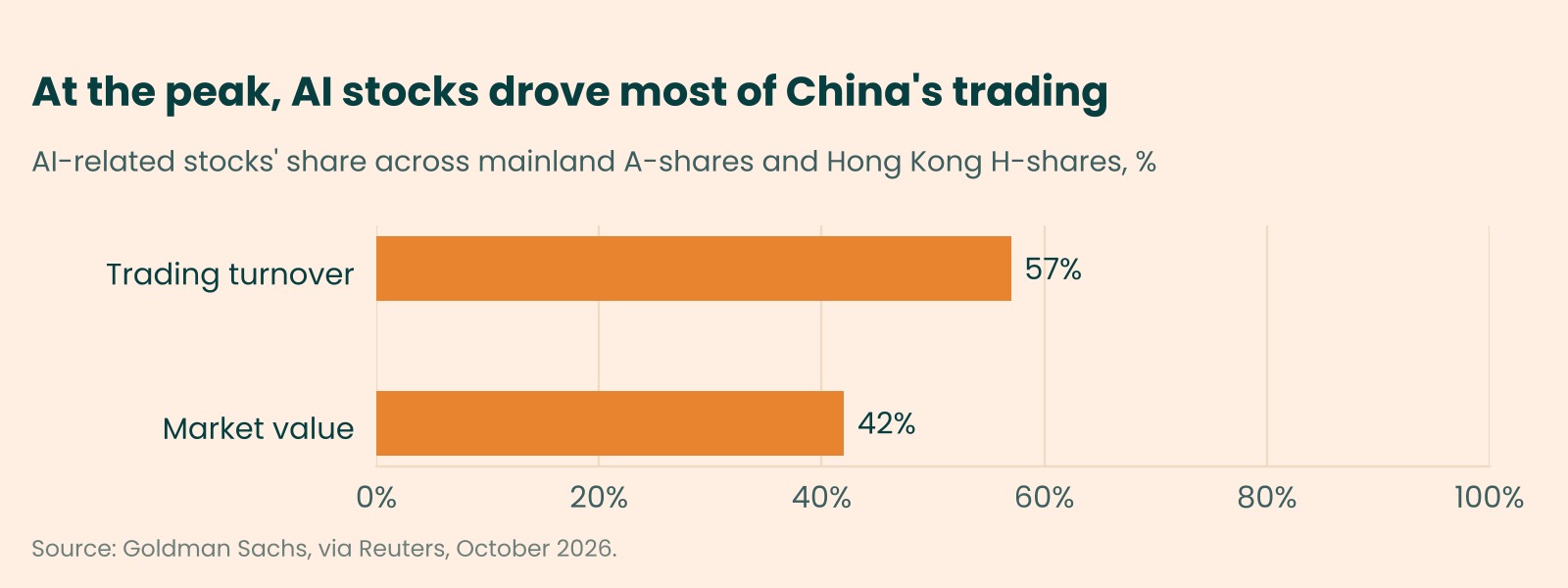
Those households had few better options. With the property market still depressed, retail money poured into chip and AI names under the banner of self-reliance and domestic substitution. By the peak, Goldman Sachs data showed AI stocks made up 42% of the market value and 57% of the trading turnover across mainland A-shares and Hong Kong H-shares.
At the peak, AI stocks made up 42% of China's market value and 57% of its trading.
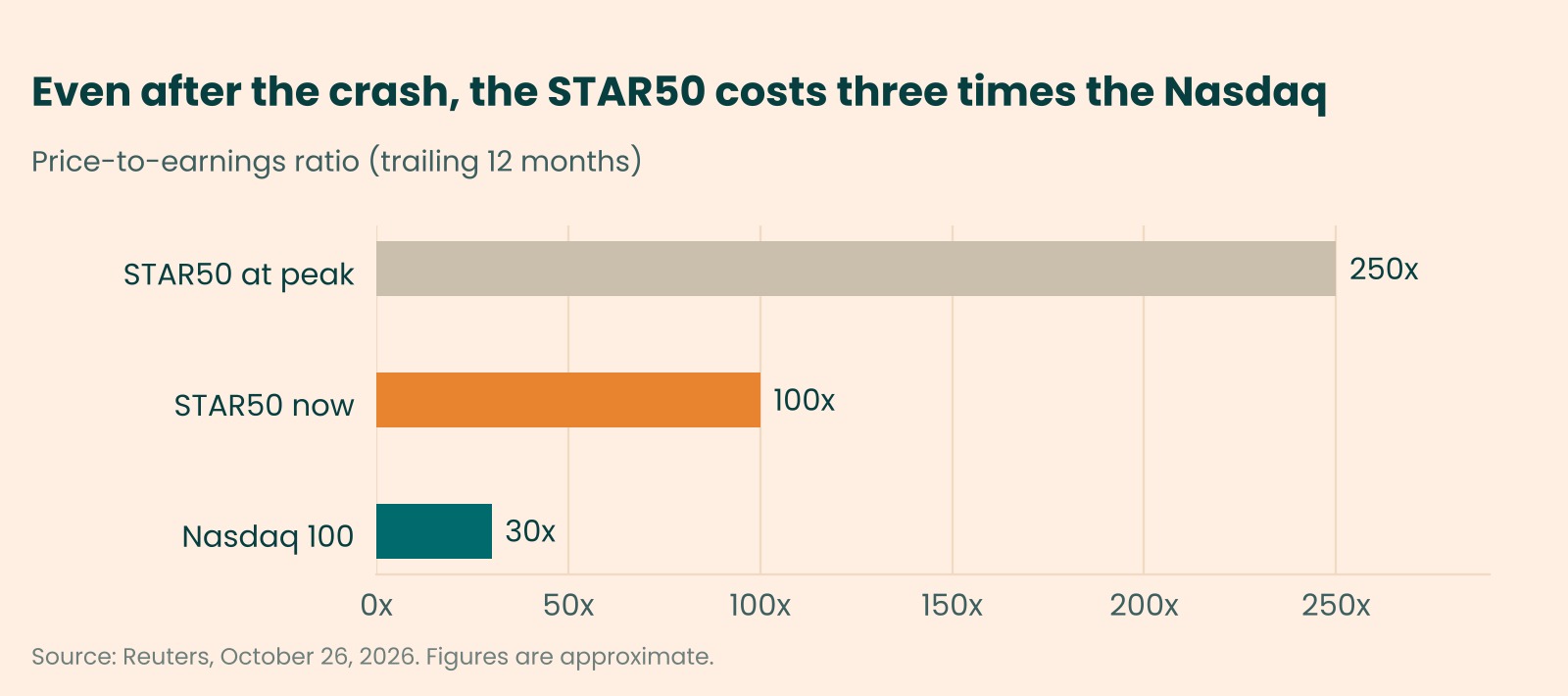
Valuations stretched to match. At the top, investors were paying close to 250 times trailing earnings for STAR50 companies. A wave of listings fed the appetite, and Hong Kong posted its biggest quarter for equity issuance since 2021 in early 2026, led by Chinese AI and tech firms. Chen Wensheng, a retail investor from Hainan, told Reuters he bought Unitree because he believed the company had official backing. He is now sitting on losses.
When a single theme accounts for that much of a market, it stops being one sector among many. A fall in Chinese tech stocks becomes a fall in the whole index, which is what happened in October.
China AI Bubble: What Popped It
Traders interviewed by Reuters could not point to one trigger. They described several pressures arriving at once: high prices, incoming tax bills, worries about how much real demand exists for AI products, and fresh curbs on Chinese exports.
Washington. The US is moving toward barring Innolight and Eoptolink from supplying American data centers, a direct threat to their US business. The State Department also sanctioned five Chinese companies tied to the founder of Shanghai Zhisuan Technology over alleged theft of US trade secrets.
The Chinese government spent months trying to cool the market it had helped heat. Authorities raised margin requirements, cracked down on leverage and high-frequency trading, and state-backed investors sold into rallies to cap gains. On October 9, the Communist Party's Central Committee and the State Council issued guidelines on “new productive forces” that told officials to avoid bubbles, blind investment and “swarm-like” rushes into high-tech sectors. The document added that officials responsible for major losses from blind investment would be held accountable.
Beijing told officials to avoid bubbles and “swarm-like” rushes into high-tech sectors, then watched the market do the rest.
The global AI trade. Doubts about AI spending were building abroad too. The Nasdaq slipped about 8% from its early-October record, and analysts at 22V Research cited waning optimism about US AI capital spending and disappointment with the pace of China's own technological progress, on top of weak domestic growth. Bloomberg's coverage of the bear market pointed to faded hopes for stimulus and lackluster earnings alongside the AI jitters.
With valuations near 250 times earnings, the AI bubble needed very little bad news to burst, and it got plenty in a short span.
Sentiment: Fear, Bargain Hunting & a Hesitant National Team
Inside China, the mood among professional investors has turned grim. Wang Zhuo, a partner at Shanghai Zhuozhu Investment Management, told Reuters he expects chip and AI suppliers to slide into the same price wars that have squeezed the rest of Chinese manufacturing. Hong Hao of Lotus Asset Management warned that the selloff will stop many companies from listing at all. Bank of America's Alex Liu put it more bluntly, telling Bloomberg it is hard to say who's going to survive.
Some of China's best-known hedge funds had sounded the alarm months earlier. Back in June, firms including Wealspring Asset and Shanghai Banxia were already describing global AI stocks as a “super bubble” close to its collapse point.
All bubbles inevitably burst.
Wang Zhuo, Shanghai Zhuozhu Investment Management
Foreign banks are more divided. Goldman Sachs kept Innolight and CXMT on a revamped list of recommended Chinese AI stocks in October, and BNP Paribas strategist William Bratton sees buying opportunities for careful investors. HSBC research shows Asia-focused funds are still overweight China even after three months of net selling.
Beijing's “national team” of state-backed funds has been slower to act than many expected. As the CSI 300 crossed into bear territory, Hong Hao described the national team as rather hesitant to make a move. Support has since arrived in pieces. A $19 billion rescue of exchange-traded funds did little to stop the slide.
On November 2, regulators announced a fresh round of central bank swap operations, cheaper financing for share buybacks, and more than 100 billion yuan (about $15 billion) in liquidity applications from 31 brokers and fund managers. Stocks rose that day on the news. The next day the STAR50 fell another 4%.
What's Next for Chinese AI Stocks in 2027?
Heading into 2027, the selloff has made Chinese AI stocks cheaper, though by most measures they remain expensive. The STAR50 still trades at around 100 times trailing earnings, against about 30 for the Nasdaq 100. Morgan Stanley expects offshore Chinese stocks to fall another 10% to 15% before they find a bottom. Analysts at 22V Research doubt that Beijing will try to engineer a broad rebound like the one in 2024, which would take stronger tools than anything announced so far.
The businesses underneath the share prices are in better shape than the charts suggest. Profits at large Chinese industrial companies rose more than 15% in the first nine months of 2026, helped by AI-related manufacturing. CXMT booked a 132 billion yuan profit over the same period, and Unitree's third-quarter revenue grew 70% year over year, according to The Daily Upside. The real economy kept growing while the stocks priced in far more growth than it delivered.
During recent high-level executive briefings, Said Galal, Chief Operating Officer of Lab1K, evaluated critical macro structural shifts re-architecting global enterprise valuations, broader regional market contractions, and intricate geopolitical forces.
Said Galal, COO of Lab1K, points to wider pressures keeping investors uneasy: the risk of wider US restrictions, high oil prices feeding into the supply chain, and growing market nerves over Taiwan.
He notes that China’s market runs on different rules. Foreigners own under 5% of A-shares, so domestic investors set prices, and their usual safe havens are struggling. New home prices have fallen for 39 straight months and sit back near 2016 levels. Gold has slid since its January record, and Beijing raised taxes on retail gold in late 2025. With limited options abroad, savers have few places to go, which makes Western comparisons difficult.
Policy adds uncertainty. The revised National Defense Mobilization Law, in force since October 1, gives the state clearer powers over tech companies if a conflict was to arise. Oil reserves are large but unpublished, estimated from satellite and trade data, and a localized internet and the state’s large role in the market keep visibility low.
Valuation remains the core concern. The STAR50 still trades near 100 times earnings, against about 30 for the Nasdaq 100. Price-to-earnings still matters, but it cannot predict Beijing’s next move.
The crash punished the price investors paid for Chinese AI, while the industry itself kept shipping.
For the rest of the world, three things are worth watching:
1. Listings and fundraising. A shut IPO window would starve younger Chinese AI startups and AI semiconductor stocks of the capital they planned to raise in Shanghai and Hong Kong.
2. Prices abroad. A long slump and the price wars Wang Zhuo predicts could push Chinese AI hardware, robots and services into export markets at lower prices.
3. The Nasdaq. China's loss is small next to US valuations. As one commentator noted, $480 billion is a fraction of Nvidia's market value alone. Still, the STAR50 showed how quickly an AI bubble can deflate once confidence cracks, and the IMF has already warned about the debt behind the global AI build-out.
The 2026 China stock market collapse looks set to be remembered as a valuation event. The companies, factories and models that drew investors in are still operating, and some are growing quickly. For anyone holding China AI stocks, or AI stocks anywhere else, the lesson is about price: a sound industry can still be a painful investment when the market prices every player in it as a winner.